My contribution
I built the plugin and its agent orchestration workflow, connecting development stories with specialized agents that carry out the work.
Enterprise software · Since 2020
Enterprise systems. AI-assisted development.
Building enterprise and financial software, from technical scoping and implementation to code review and production support. Alongside Java development, I build tooling that coordinates AI agents through a test-driven workflow.

JAVA SPRING BOOT KAFKA POSTGRESQL
Warsaw, Poland
01 Professional experience

Raiffeisen Bank International
Developing functionality for financial services in a distributed, event-driven environment, with Java and Spring Boot services, Kafka integrations, and Angular interfaces.

Red Ocean
Turning business requirements into fullstack applications, from relational data models and business logic to responsive interfaces.
02 Selected work / AI developer tooling
A plugin I built to coordinate AI-assisted work on development stories. It connects to Jira through an MCP server and uses Confluence through MCP. An orchestrator delegates work to specialized agents following a test-driven development workflow.
I built the plugin and its agent orchestration workflow, connecting development stories with specialized agents that carry out the work.
The orchestrator divides story work between agents. Tests guide implementation and verification, with reusable skills providing instructions for the workflow.
Useful context, meaningful tests, and review remain essential. Splitting work between agents also introduces coordination overhead.
Step 1 of 7 · Jira issue
01 / 07 Starting point
An issue identifier gives the workflow a defined entry point. In this fictional example, retrying a request must not create a second order.
A shared problem statement keeps each agent working toward the same outcome.
Prevent duplicate order creation

Given the same idempotency key
When POST /orders is retried
Then return the original order
And do not create another order02 / 07 Coordination
The plugin can be used in VS Code and Claude CLI. This illustrative workflow shows an orchestrator coordinating specialized agents, with reusable skills providing task-specific instructions.
Explicit handoffs reduce duplicated work and make responsibilities easier to inspect.
issue: DEV-142

analysis → requirements + context
planning → implementation approach
testing → failing tests
implementation → code changes
verification → check + refine03 / 07 Requirements & context
Analysis connects the requested behavior to the existing code and identifies assumptions that need attention. Ambiguous requirements should be surfaced, not silently invented.
The right implementation starts with the right problem, especially around edge cases.
Inspect
  Order API and persistence flow

Clarify
  Same key, different payload?
  What about concurrent requests?
How long is a key retained?04 / 07 Implementation design
A plan breaks the change into small steps and makes dependencies visible before implementation. In this example, duplicate handling must account for persistence and concurrency.
A visible plan makes scope and architectural trade-offs easier to challenge early.
01  Define the retry contract
02  Add duplicate-request tests
03  Enforce key uniqueness
04  Return the existing order
05  Verify concurrent retries

Keep the change scoped to DEV-14205 / 07 Test-first development
Testing agents create tests that initially fail. These make the intended change observable and give implementation agents a concrete feedback loop.
Writing the expectation first helps prevent tests from merely repeating an implementation.
@Test
void aRetryReturnsTheOriginalOrder() {
  var first = createOrder("key-142");
  var retry = createOrder("key-142");

  assertEquals(first.id(), retry.id());
  assertEquals(1, countOrders());
}06 / 07 Focused code changes
Implementation agents work from the plan and failing tests. The change is refined using test feedback, with the existing codebase and conventions as constraints.
A narrow feedback loop keeps the change tied to its original requirements.
Validate the request
Look up the idempotency key
Return an existing matching order
Otherwise persist with a unique key
Handle a concurrent insert conflict

Run tests → inspect → refine07 / 07 Feedback & review
Test results guide another iteration where needed. Passing tests are useful evidence; engineering judgment is still needed to assess coverage, assumptions, and the final diff.
Verification closes the feedback loop without treating generated code as automatically correct.
[ ] Retry behavior matches the issue
[ ] Concurrency is covered
[ ] Existing tests still pass
[ ] Diff stays within the scope
[ ] Assumptions are documented

Failure? Return to implementation.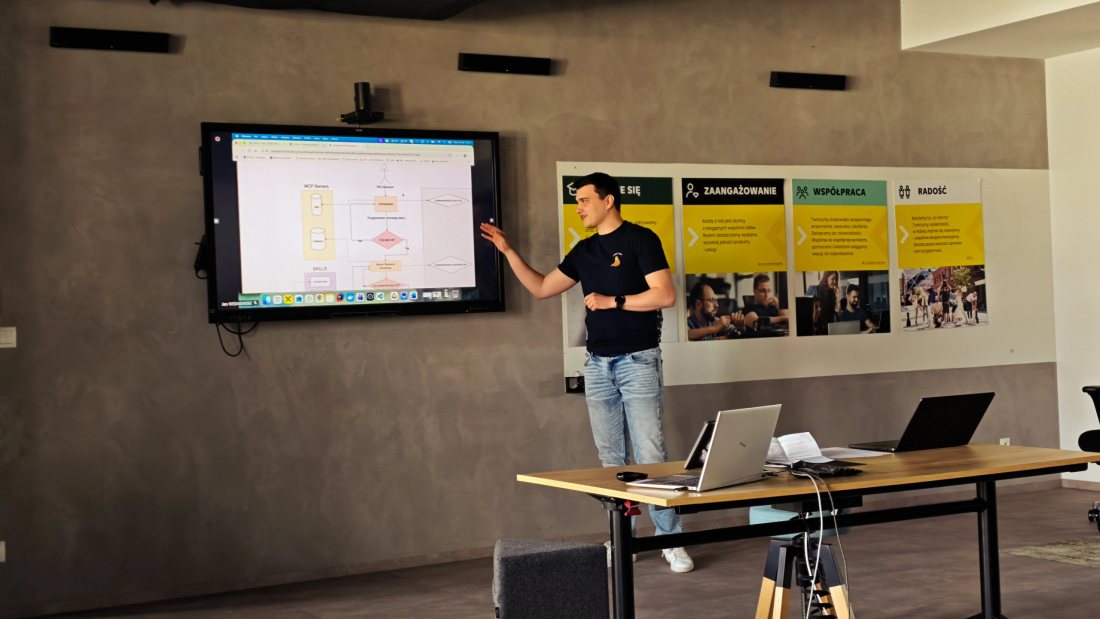

From code to conversation
Presenting how MCP, reusable skills, and specialized agents fit together in a practical development workflow.
03 Engineering expertise
Experience across implementation, production support, and developer workflows, with Angular as a complementary skill.
Implementing business logic in Java and Spring Boot, working with REST APIs, relational data, and Kafka integrations in distributed enterprise applications.
Using AI in day-to-day development and building a plugin for VS Code and Claude CLI. An orchestrator delegates story work to specialized agents following a test-driven workflow.
Monitoring services, investigating production bugs, reviewing code, and writing automated tests. My hands-on AWS experience is limited to adding service configuration values in Systems Manager Parameter Store.
Building Angular interfaces and integrating them with backend services. Frontend experience helps me follow a feature across the API boundary, while backend engineering remains my main focus.
04 About & direction
I have worked on enterprise applications since 2020, including financial services. My responsibilities connect business requirements with implementation, code review, and ongoing production support.
I am developing toward AI engineering through hands-on work on developer tooling and agent workflows. My current focus is using AI during software development and building the tools that coordinate that work.

Postgraduate studies · 2019–2020
Warsaw University of Technology

Master’s degree · 2012–2017
University of Warsaw
05 Get in touch
I’m interested in senior Java and backend opportunities where I can deepen my work on enterprise systems and grow toward AI engineering.